Happiness is a Serious Business
“I'm just here for a paycheck.”
Your employee, today
The pandemic was a tough year for everyone. Even the best companies struggled with employee engagement, motivation and wellbeing. But these struggles are symptomatic of a greater underlying issue.
A pre-pandemic Gallup survey[1] found that only 13% of all employees worldwide are engaged in their work, while a staggering 63% were not engaged, and 24% were actively disengaged. These low levels of engagement indicate a massive lack of motivation and enthusiasm for work - a costly drain in productivity and profitability.
The best companies have always known that businesses with a positive culture outperform their competitors on the stock market annually by 3%, according to research by economist Alex Edmans[2], so they ask, “Are employees engaged, satisfied and committed to the cause?” or “Would they recommend us as a place to work?” Hoping to gain a competitive advantage, they spend millions on employee engagement surveys, programmes and apps to varying degrees of success.
But what if the key to creating a positive, productive culture is to stop talking about employee engagement and start talking about happiness - people’s emotional experience of work? As radical as it sounds, that’s the premise behind what we do at Friday Pulse.

Nic Marks
Founder & CEO, FridayPulse
“Happiness is the ultimate People KPI. It predicts if teams, organizations - even nations - are building a better future. It's a clear and simple good/bad signal, that's why happiness is the perfect KPI to track an employee's experience of work.”
As a statistician and trained therapist, he’s made it his mission to help people measure happiness and talk about it. Over the last 25 years Nic Marks has been fascinated with people and data - especially data about people. He believes that emotions like happiness can be tracked and quantified. His research has brought him to meeting figures like the Dalai Lama, advising the Blair and Cameron British governments, and giving a popular TED talk about his work with governments designing well-being indicators and the Happy Planet Index. Recently, he studied the personal happiness and wellbeing of over 75,000 people and 9,000 teams. This work led to understanding five key indicators of happiness at work.
In short, to Nic, happiness is a serious business.
A happy employee is an engaged employee - that much should be obvious.
As a result of Nic’s original research, Friday Pulse has the data to prove it.
Psychologists have long understood that emotions help us interact with our environments. So-called negative emotions - such as anger and fear - help us avoid threats, and while they serve a useful purpose in the world at large, in a work context they result in apathy and increased turnover. On the other hand, positive emotions - such as enthusiasm, pride, interest and enjoyment - help us create and seize opportunities, which, in our organizations, means greater loyalty, productivity and creativity.
In a business context, these emotions are the difference between underperforming teams and successful teams.
And the difference is quantifiable.
The Truth about Employee Engagement
“You already take all my time. What more do you want from me?”
Your employee, today
What is Employee Engagement?
Focusing on happiness instead of engagement is a major shift in business thinking, but it has a compelling upside. Happiness is far easier to measure because there is a fundamental flaw to asking about engagement. No one can really answer the question, “How engaged are you at work?” The definition of employee engagement differs in every organization, but there’s always a cloud of ambiguity that employees have to sift through. “Engagement” can mean any of a number of metrics that are perceived to increase performance and productivity - efficiency, satisfaction, work hours - and is often defined as a combination of these.
As a result, the question doesn’t deliver a clear and simple measure.
The truth about employee engagement is that while it’s a useful tool for management, it’s terrible for employees. There are few things that sound as impersonal and corporate as engagement - it conveys an arm’s length relationship. Emphasis on engagement almost always sounds extractive, like the only thing the organization cares about is getting more from its employees. This is demoralizing for employees who may already feel like they’re giving their all.
Factors of Employee Engagement
Most measures of engagement, such as Gallup’s Q-12, focus on drivers like progression or recognition and don’t measure the end result. This is like measuring a sales team’s performance based on the number of calls it made rather than revenue generated, or a surgeon’s record by number of operations performed rather than patient recovery figures. In practice, this means Gallup makes the assumption that all 12 of their questions have the same effect as each other and remain the same in every setting - unlikely in the real world.
Why Happiness?
“You know I'm human right? There's more to me than what I can produce.”
Your employee, after their concerns aren't heard
Happiness, on the other hand, is a concept with which everyone can relate. When an organization focuses on happiness, it communicates that it’s interested in the individual, not just what the individual can do for the organization. The main strategy here is to build trust and put employees at ease rather than turning the screw. Trust is the foundation of every successful relationship and the key to helping people feel cared about.
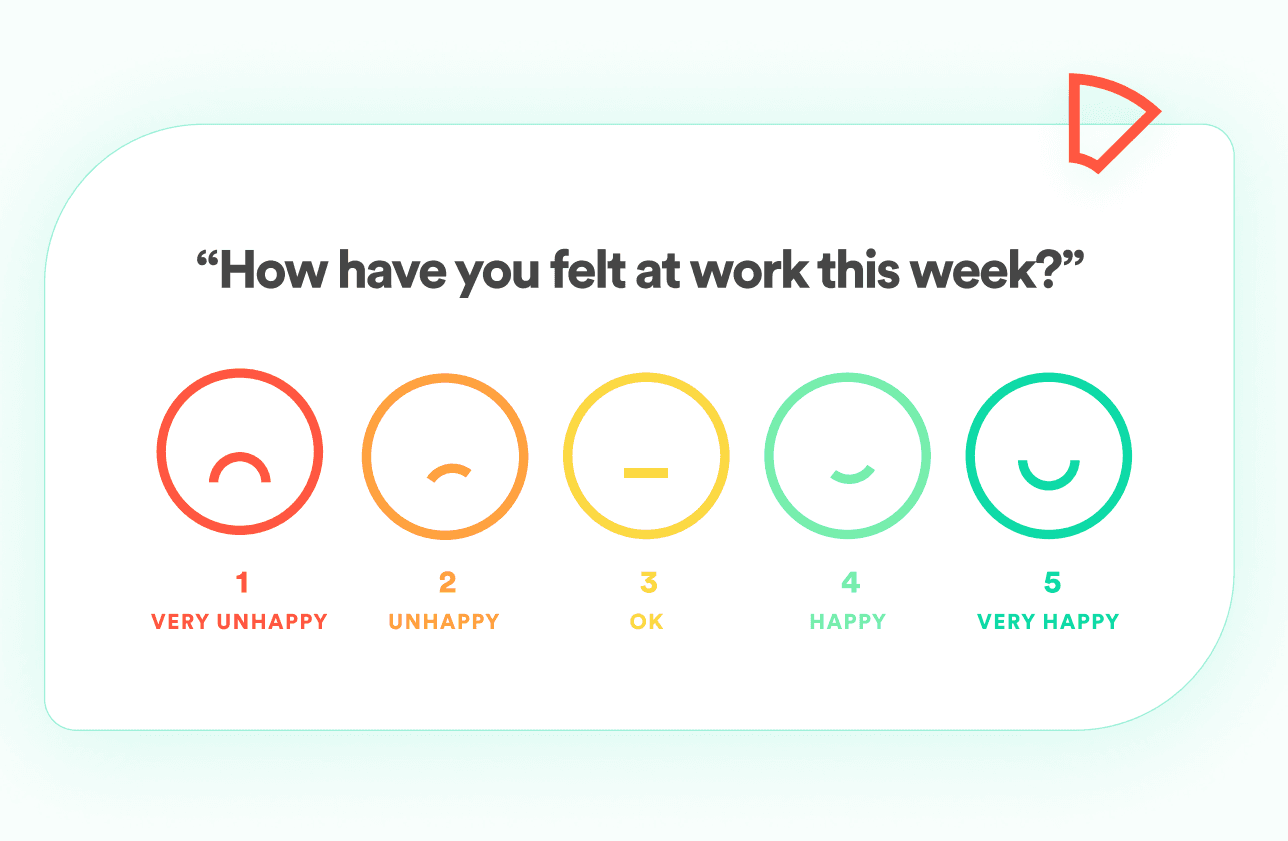
Replacing the vagueness of engagement surveys with, “How have you felt at work this week?” provides a question that everyone can easily answer from “very unhappy” to “very happy”. It’s important to emphasize that this question focuses on the last week. Setting a time period eliminates vagueness because it’s a discrete period of time to reflect on - the working week. Asking every week clearly demonstrates that the organization cares about their employees as well as giving them an opportunity to provide a simple honest answer. In a sense, it gives employees a voice.
The simplicity and honesty of their answers is why the weekly happiness question is the foundation of our Happiness KPI™. In terms of work experience, it’s the equivalent of how much revenue is generated in a business or how many patients have recovered in a healthcare setting. It is an outcome measure.
Happiness in a work context still requires guidelines to be a measurable goal. Understanding the drivers of happiness, which we call The Five Ways to Happiness at Work, provides additional valuable insights. While the Happiness KPI™ scores how teams really feel about work, The Five Ways to Happiness at Work demystify culture by profiling what organizations need to focus on every quarter.
We’ll talk more about The Five Ways later in this article.
The Business Case for Happiness
For years employers have known that focus on the individual - their interests, their needs, their goals - will often bring about greater results than trying to run a one-size-fits-all annual survey. When that focus is tied to happiness specifically, interesting results emerge. Over the years we’ve seen a strong correlation between workplace happiness and business success.
Retention
Average tenure for millennials is 2.8 years, with 53% leaving in the first year.[3]
In our own client data, unhappy employees are twice as likely to leave their job in the next quarter.[4]
Productivity
Since the 2008 financial crisis, global productivity growth has slumped to below 2% per year.
Teams with low morale are an estimated 28% less productive.[5]
Business Value
55% of CEOs think their businesses will grow by less than 2% over the next three years, according to KPMG.[13]
Companies with a positive culture experience 3% year-on-year extra share-price growth, according to research by Edmans, Li & Zhang.[6]
The Happiness KPI™
“Our team struggled, but our team leader took the time to listen to our concerns. We're better for it.”
Your employee, tomorrow
How to Engage Employees the Right Way
The best way to create a positive work culture is to help teams and organizations learn for themselves. Over the last six years, Friday Pulse has worked with over 1,000 organizations to measure and improve happiness at work. Combined with over 25 years of research, Friday Pulse has developed the ultimate people metric: The Happiness KPI™.
The Happiness KPI™ runs from 0-100, with very unhappy teams scoring 0 and very happy teams scoring the maximum 100. Every team score is presented in a dashboard so teams’ experience of work can be dynamically monitored and tracked. This, in turn, allows team leaders to be responsive to immediate issues or challenges.
Employees are posed a simple question in a weekly pulse check: “How have you felt at work this week?” that everyone can easily answer from “very unhappy” to “very happy”.
Then that data is fed to a reporting system that displays the most recent results as well as trend data. It also tracks participation and response rates across the organization to highlight areas that may need help.
As a core people metric, the Happiness KPI™ can be used to determine future business success. For instance, our research has shown that a 10-point increase on the Happiness KPI™ typically leads to a 5% rise in productivity and a 14% fall in staff turnover. In this way, efforts to help employees can be tracked and measured.
So, what does Friday Pulse look like in the workplace?
ProSearch provides eDiscovery solutions to Fortune 500 corporations and their legal departments. In 2014, they hit on the idea that a focus on happiness would help employees thrive in an industry defined by fast-paced technological innovation. That’s when they came to us.

Gina Taranto
Ph.D. Executive Director and Happiness Sponsor
ProSearch
“Our experience has been that cultivating happiness can lead to employees who are confident, engaged, and (yes), happy. Happy employees take pride in being experts in their job and are well-suited to collaborate. A happiness focus engenders a culture characterized by both high performance and low attrition, which allows our team members to develop substantive relationships with our clients.”
With happiness as a KPI, ProSearch has been able to predict employees that may be leaving and intervene to prevent the costs of hiring new staff. Teams are empowered to take actions to remove frustrations and improve team morale before issues get too ugly to talk about. This happiness data also provided insights to a core group of senior-level employees accountable for driving the profitability of the company.
The Science Behind The Happiness KPI™
“I think everyone should work here. This is a place where they see you as human and actually care about you.”
Your employee, tomorrow
For a concept like happiness to gain any traction in a business context, there has to be real evidence and proof. There has to be a sensible grounded methodology that gives shape to the framework. This is where our research and studies into the science of happiness showcase why it’s an important topic in the workplace.
How We Measure Happiness
When it comes to happiness there are three ways of measuring it:
Experience sampling. People are asked how they feel right now. The approach started with the arrival of pagers in the 1980s and creates very nuanced data on how mood changes through the day. However, respondents usually find it quite (very) annoying to be constantly interrupted with requests to do a mini survey.
Cognitive assessments.People are asked how their lives are going overall. This approach is popular in surveys that are administered infrequently and is the method used by most annual employee engagement surveys. While this method does capture an overall picture, it also conceals a lot of different competing factors by essentially reducing a participant’s varied experiences to a year-long average.
Episodal measurement. People are asked how they experienced an episode directly after it ends. Respondents are asked about a time period like their day yesterday or the past week. This approach is less intrusive than experience sampling while still creating responsive data that captures the natural ups and downs of life.
At Friday Pulse, we employ episodal measurement for measuring employee happiness because it creates a simple, time series that captures the dynamic nature of our experience of work. In our 25 years of research, we experimented with varying lengths of time and looked at the impact of experience sampling and cognitive assessments.[10] We tried daily, weekly and monthly episode frequency before determining that the working week is the most natural and relatable episode of work.
Since most people have a working week that comes to a close with a weekend break, the pulse is taken at the end of the working week. The week’s end is a natural time to reflect back on how the week has gone. Moreover, there is strong evidence in our research that consistent, incremental monitoring is more effective at creating positive change than big, occasional efforts. The incremental effect is cumulative and creates longer-lasting change while building trust along the way, which makes once a week better for real change than once a quarter or year.
Time-bound measurement mirrors how we naturally evaluate our experiences in real time - we review and talk about our days, weeks, or months, and we also naturally evaluate whether that time period was good, bad, or neutral. Neutral feelings tend not to trigger much of a reaction in us, but very good or very bad things demand our attention - they energize us to do something.
The Effect of Happiness Over Time
Measuring happiness on a weekly basis makes tracking employees’ experiences of work very straightforward. Time-series data is important in providing accurate insight into employee wellbeing because it’s natural for happiness to ebb and flow. It offers the best of both worlds - insight into short-term factors and patterns, as well as monitoring of long-term trends and reactions over time. Everyone will have bad weeks from time to time, that’s natural, however when trends emerge then careful action needs to be taken before bad weeks turn into something worse.
This has never been better illustrated than during the recent pandemic. When COVID-19 struck, our platform identified a large drop in employee wellbeing across all of our clients, in every industry at the same time. This global setback was also evident in data gathered by the UK polling company YouGov, who throughout 2020 asked a representative sample of 2,000 people how they had felt each week - what they call tracking “Britain’s mood, measured weekly”.[15]
COVID-19 affected workers’ happiness dramatically.[11] The first wave in March 2020 resulted in a huge dip in weekly happiness levels due to high levels of anxiety and sudden disruptions to how we work.
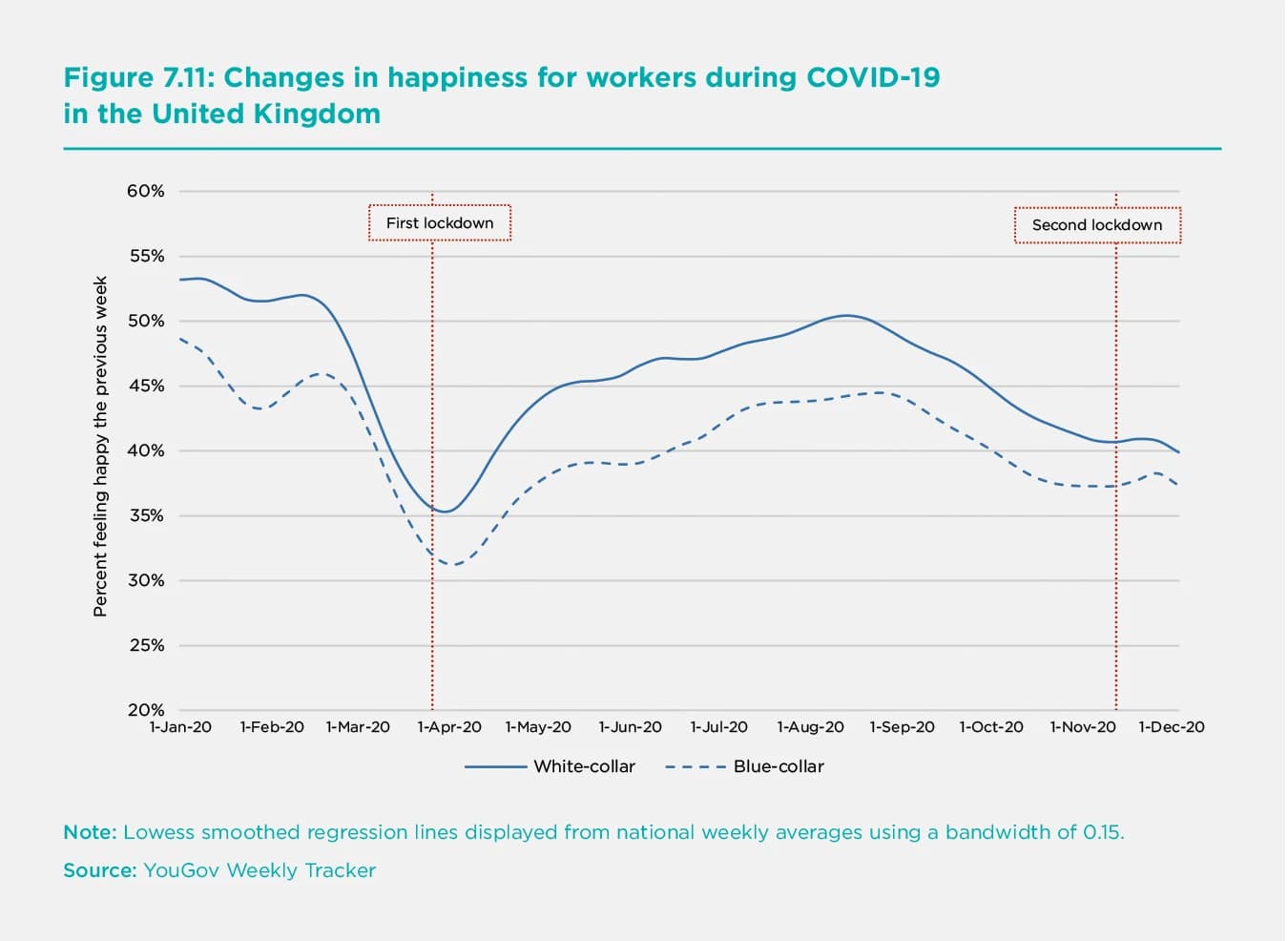
There was then a slow, 13-week recovery back towards near pre-pandemic levels of worker happiness, with a second fall as restrictions continued. When we compare that same timeline with Friday Pulse weekly happiness data, our clients reported:
- An 18% drop in their weekly happiness scores in March 2020, compared to a 30% drop reported by white-collar workers.
- A return to 90% of pre-pandemic happiness levels in just 3 weeks, compared to 13 weeks.
- End-of-year employee happiness levels 20% higher, with 47 weeks at (or above) 90% of pre-pandemic happiness levels, compared to 20 weeks.
How a wellbeing-focus builds lasting resilience
Effect of Covid-19 on weekly employee happiness
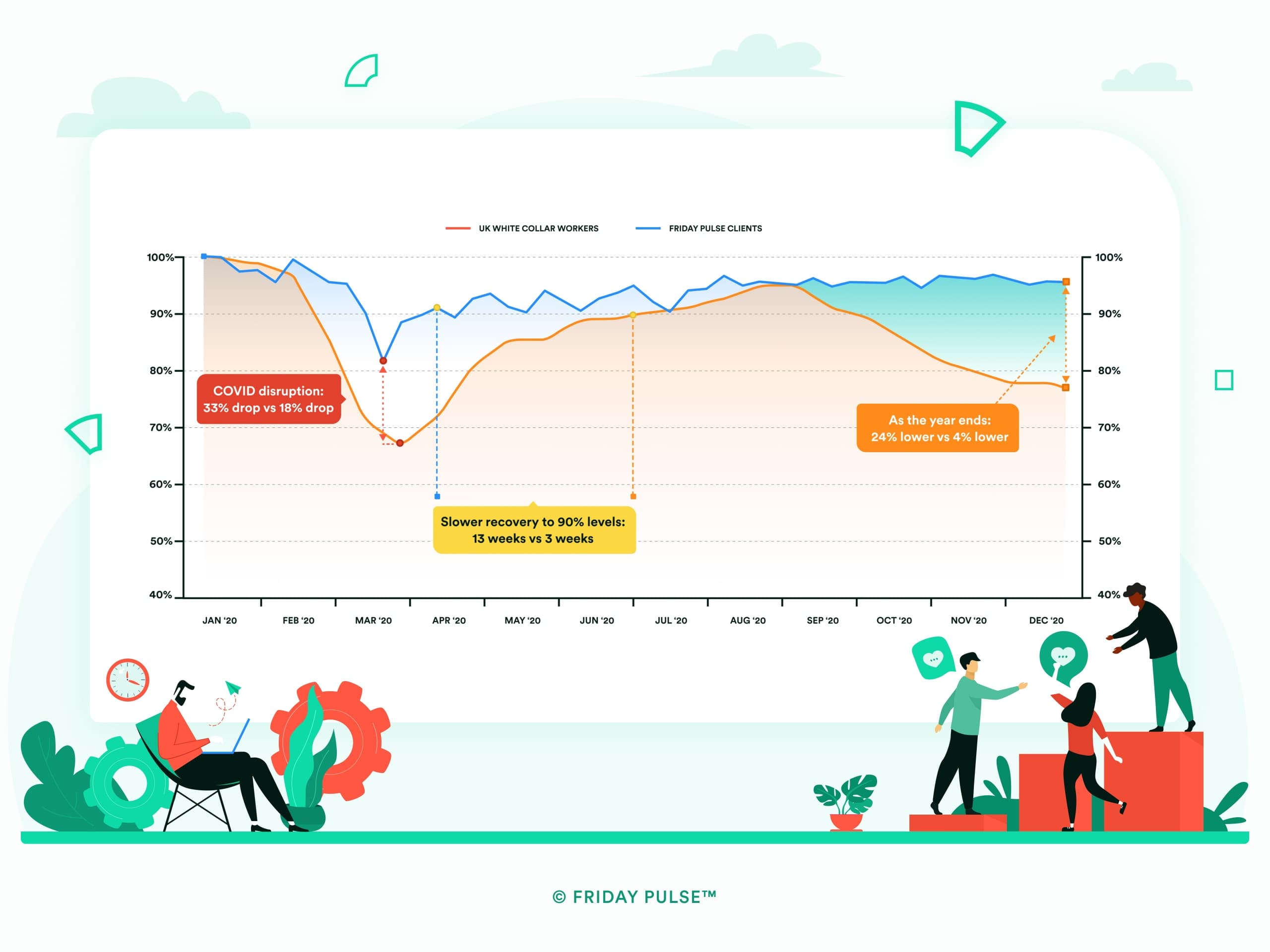
These insightful patterns can only emerge by measuring employee experience every week.
The second wave of lockdown proved particularly revealing. While the rest of the UK’s white-collar population experienced a steady decline in their happiness scores, Friday Pulse’s wellbeing-focused companies displayed remarkable resilience by maintaining their happiness levels.
Dr Jan Emmanuel De Neve, one of the writers of The World Happiness Report and director of the Wellbeing Research Centre at Oxford University, said,
“What gets measured gets done. Companies that care enough about the wellbeing of their employees to be pulsing it regularly had their staff cope much better with the fallout of the pandemic. Even putting aside the direct links between employee wellbeing and performance, COVID-19 revealed which companies were better than others at helping their employees navigate the difficulties of the pandemic. They were the ones best at relieving employee stress which is not only good for business, it is also a social benefit.”
Dr Jan Emmanuel De Neve
Director, Wellbeing Research Centre, Oxford University
How Weekly Data Supported Our Clients Through COVID
Our own clients were not immune to the impact of COVID either. Their happiness scores were on average 6% lower than pre-COVID levels. However, the YouGov data shows they fared much better than the general population of white-collar workers, whose scores were on average 16% lower than their pre-COVID average happiness levels.[12]

Julia Hasenthal
Founder & CEO
ProSearch Strategies
“Other CEOs can only guess at how the pandemic has impacted their employees. I know because we track employee experience every week. At ProSearch, we have been able to act on this weekly data, and it has helped us navigate our way through the COVID-19 crisis.”
Having this nuanced data available every week on a team-by-team basis enables senior leaders to immediately see how teams are doing, including, critically, how they respond to setbacks, new initiatives or team changes. This is the simple good/bad signal in action.
When a certain team has a bad week, a senior or HR leader can flag this and revisit their happiness scores in the following weeks to see if they recover by themselves. If after three weeks teams continue to show low scores, they should take note.
An intervention might be necessary to understand what the problem is - a bad manager, a slacking member of the team, overwork, inefficient meetings, harassment, etc. - and resolve it. This is why weekly happiness is such a good measure. If you only checked in each month, this pattern would take 2-3 months to emerge rather than just 2-3 weeks.
Building Trust and Convincing Sceptics
Employees will only give honest answers and usable data if they trust senior leaders will actually make changes.
This is a key factor in creating lasting change. All the best intentions and initiatives in the world will not move employees, if they do not trust their leaders to listen and take action. This is evident in the way employees reacted to Friday Pulse in several of our clients.
In the case of the Auctus Group, a company that has worked remotely to provide financial growth opportunities to dermatologists and plastic surgeons in the United States, most of their teams were remote, but they were able to maintain high response rates because employees saw that their data mattered. The data they generated fed team conversations. Action means employees can trust their scores.
Another example is Millstream, a UK business that specialised in accident, health, and travel insurance. They knew that culture had a tangible competitive advantage but weren’t sure how to sustain that advantage as they grew. When they started to use Friday Pulse in January 2020, they had no idea a pandemic would send everyone into work-from-home situations. As travel insurance claims escalated dramatically, Millstream’s focus quickly switched to self-care, team-care and getting work/life balance under control.
With some coaching from Friday Pulse combined with the habits they’d established around measuring and discussing work experiences, Millstream was able to recover to pre-COVID levels of happiness by August 2020. They were also able to make significant improvements in how people scored in Work-life balance, Appreciation, and Fairness and Respect.
The Friday Pulse approach even helped persuade a previously sceptical director of its value.

Roberto Amati
Managing Director
Millstream Underwriting Limited
“I was initially sceptical about the potential benefits when we kicked off with Friday Pulse, but it is the one tool of this nature that has really made a difference. When you boil it down, it keeps culture and the soft side of running a team front-and-centre in people's minds and on the agenda every week.”
How to Actively Build Happiness in Your Company
“This is a place where they really help you grow. They don't stifle my creativity, and they let me take risks. I love it here.”
Your employee, tomorrow
Real Change Starts at the Team Level
Weekly tracking of the Happiness KPI™ forms a foundation for creating positive change in the workplace, but more is required. Having weekly team meetings where employees are recognized for achievements and given a voice to speak concerns is a start to the process, but in order to effect real change, your company needs to be aware of the factors that influence happiness and have a strategy in place of changing them.
We are well aware of the inherent challenges to be found in the bigger picture. That’s why we have also developed a framework for looking after culture which we’ve named The Five Ways to Happiness at Work. This scientifically robust approach is the product of 25 years of original research and demystifies company culture by profiling what organizations need to focus on, every quarter. Our research has determined that focusing on the following factors leads to a much happier and more productive workplace:

Connect
It’s much easier to do great work when we get along well with our colleagues.

Be Fair
Being treated with fairness and respect is fundamental to happiness at work.

Empower
Sharing responsibility can unleash amazing potential in organizations.

Challenge
We are happy in our jobs when we are creative and progressing our work.

Inspire
Doing a job that we feel is genuinely worthwhile is a great source of motivation.
Employee happiness drops when these factors are neglected but ensuring that these five factors are addressed is a sure way to improve employee happiness across your company.
Team Meetings
The Happiness KPI puts a number on team morale and helps people pay more attention to it. However, it’s a number that doesn’t improve happiness on its own. The cadence of weekly measurement needs to be matched with the cadence of acting. Weekly team meetings are this opportunity. In these meetings, team leaders can slowly build trust. It’s where people’s personal wellbeing and business goals can be aligned. As happiness scores fluctuate from week to week, it’s important to hold these meetings weekly to make adjustments as necessary.
When team meetings are largely virtual, they lose the small talk that goes on before and after meetings. From a productivity standpoint, this is great - less talk means more work, right? From a team relationship point of view, this is bad. The idle chat is not really idle at all - it serves the purpose of allowing team members to get to know each other better. It also gives people space to ‘read a room’ and determine the mood. This is not to say that team meetings should be long or go off topic often, but there should be some space for small talk.
Another proven method of developing empathy between team members is to have the team meeting at the beginning of the week. During this time, teams can reflect on the events of the previous week - what went well and what didn’t - in addition to the week’s tasks. The team meeting is a critical place in acknowledging and appreciating people’s efforts, while listening to frustrations. In this way, team members and leaders can become more supportive of each other.
Empathy and Boundaries
As companies adapt to new working conditions, it’s important to be empathetic. Some people may not have a quiet place to work from, and others may have family obligations to take care of in the middle of the workday. Be empathetic to everyone’s struggles. Set aside time to listen to your team and whatever is happening in the workspaces.
At the same time, it’s important to make sure there are boundaries set for what is appropriate behavior. Messaging people every hour to see if they are working decreases trust. Likewise, respect people’s ‘work hours’ and their offline time. Just because people are working from home, it doesn’t mean they’re always going to be available.
Maintain Core Relationships
Our core relationships are what sustains us through good and hard times. An Oxford study revealed that our core social network is made up of up to five intimate friends and 15 close ones. We spend about 40% of our emotional time and efforts towards the five, and 20% on the remaining ten in our circle. In other words, our core 15 always command 60% of our attention.
This kind of social circle applies to our work relationships as well. Some of our core group of people may be on our teams, or in other departments. Preserving these relationships with them is absolutely critical to making sure teams work well together while remote working.
Remember, it’s not just about the work you do, but the relationship and bond you have. In normal work settings you may share funny stories, go have a coffee together, or just chat. Keep the chat going. While remote working, have social calls and chat in the same way. Laughter is a great way of keeping people connected while physically distant and can reduce feelings of isolation.
The Future of Work is Here
The world of work has never had to change as rapidly as it has in 2020. While increased remote working was on everyone’s radar as a trend, no one could have predicted that nearly all offices would be sitting empty with most people working from home. Many businesses have a fight for their very survival and even those that operate in sectors that are less affected have had significant challenges.
Remote working has put a new pressure on teams and team leadership. In every industry, employee mental health and wellbeing is a high priority. This is where tools like the Happiness KPI can really help.

Dominic Monkhouse
CEO & Business Growth Coach
Scaling Up
“By trailing positive and negative emotions, and regularly collecting feedback, Friday Pulse gives insight into employee wellbeing and, specifically, how individuals and teams are faring. As we continue to adapt to this new reality, this level of data is invaluable.”
Through our work, we have seen clients raise happiness levels across their whole organization, and we have also seen individual team leaders make significant differences to their teams’ scores. At Friday Pulse, it’s our calling to make improving happiness a real and tangible process.
In that light, our positive feedback loops help companies implement the Happiness KPI™ and measure the result. The feedback loops also help teams identify different influences and factors that contribute to or detract from a team’s happiness. They’re for teams and strategic business leaders intent on driving cultural change.
References
- [1] Gallup: State of the Global Workforce (2017).
- [2] Alex Edmans (2020): Grow The Pie - How Great Companies Deliver Purpose & Profit.
- [3] See for example: U.S. Bureau of Labor Statistics, “Number of Jobs Held, Labor Market Activity, and Earnings Among the Youngest Baby Boomers: Results from a Longitudinal Survey,” BLS News Release (March 31, 2015).
- [4] Source: Friday Pulse client data tracked over 3 years.
- [5] Estimate from a combination of Friday Pulse client data plus broader research such as Harter et al. (2010) Causal impact of employee perceptions on the bottom line of organisations; Perspectives on psychological science 5(4); 2010.
- [6] Edmans, Alex and Li, Lucius and Zhang, Chendi, Employee Satisfaction, Labor Market Flexibility, and Stock Returns Around the World (February 21, 2017). European Corporate Governance Institute (ECGI) - Finance Working Paper No. 433/2014.
- [7] https://www.peoplemanagement.co.uk/news/articles/12-million-working-days-lost-to-work-related-mental-health-conditions
- [8] Friday Pulse research including with Robert Half (the global recruitment firm). Robert Half (2017) It’s time we all work happy. The secrets of the happiest companies and employees.
- [9] Krueger, J. & Killham, E (2007) ‘The Innovation Equation’. Gallup Management Journal. Isen, A. M., Daubman, K. A., & Nowicki, G. P. (1987). Positive affect facilitates creative problem solving. Journal of Personality and Social Psychology, 52(6), 1122.
- [10] Marks, N and Thompson, S (2008): Measuring Wellbeing in Policy: issues and applications. Report to the UK Government Foresight Project on Mental Capital and Wellbeing.
- [11] In order to make as fair a comparison as possible we have re-calibrated both sets of data as a % of their pre-pandemic means. As an indication of the scale of these drops, they are of the order of 6-7 standard deviations below the mean - the word “unprecedented” is entirely appropriate here.
- [12] Note that in the YouGov survey the pre-pandemic average was 51% of white-collar workers responding that they were happy last week whereas in the group of Friday Pulse clients 68% of their employees responded happy or very happy last week. The questions are asked in different contexts so whilst it is highly likely employees in Friday Pulse clients are happier on a weekly basis, by only making a comparison to the pre-pandemic averages we are making more modest claims and are on stronger ground statistically.
- [13] KPMG (2018): Global CEO Outlook.
- [14] Deloitte (2019): Global Human Capital Trends - only 9% of respondents said they felt “very ready” to address the employee experience.
- [15] YouGov: Britain's mood, measured weekly (tracking since July 2019).
We are regularly conducting research to broaden our understanding of happiness in the workplace and creating strategies to help teams be happier.
If you are interested in learning more about how Friday Pulse and the Happiness KPI™ can make a difference in your organization, reach out to us today.
Try Friday Pulse nowThe Workplace Happiness Experts
Founded by Nic Marks, leading statistician, happiness expert and TED speaker, Friday Pulse interprets people data to help companies understand employee wellbeing. Over the last six years, Friday Pulse has worked with over 9,000 teams across 1,000 organizations, measuring and improving workplace culture.
